


Grape Anatomy: How the Structure of a Grape Shapes Wine
A grape may look simple, but inside it are the sugars, acids, pigments, tannins, and aromatic compounds that form the foundation of wine. Understanding the skin, pulp, seeds, and their roles in winemaking offers a clearer way to understand why wines differ in color, acidity, texture, and aroma.
Why Grape Anatomy Matters in Winemaking
Wine begins with grapes, but the relationship between a grape and the finished wine is more complex than simply pressing the fruit and fermenting the juice.
A grape berry is made up primarily of skin, pulp, and seeds, with vascular tissues and the pedicel forming part of its supporting structure. Each part contains different compounds, and the way those compounds are extracted or transformed during winemaking influences the character of the finished wine.
For example, the pulp provides most of the juice, including water, sugars, and organic acids. The skin is an important source of pigments, tannins, and aromatic compounds, while the seeds contain significant amounts of phenolic compounds and tannins.
This means that when a winemaker decides how to crush the grapes, how long to macerate them, whether to include stems, or how to manage fermentation, they are also deciding how different components of the grape will contribute to the wine.
A useful way to think about it is:
Grape structure → Chemical composition → Winemaking extraction → Wine character
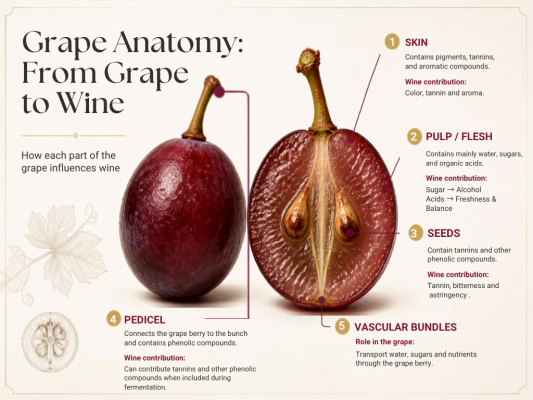
The Skin: Color, Tannin and Aromatic Compounds
The skin is the outer layer of the grape berry. It protects the fruit, but from a winemaking perspective, it is also an important reservoir of compounds that influence wine.
In red grape varieties, the skin contains anthocyanins, the pigments responsible for much of the red, purple, and blue coloration associated with red grapes and red wines. Grape skins also contain tannins and other phenolic compounds, as well as compounds and precursors associated with aroma.
This becomes particularly important during red winemaking.
After the grapes are crushed, the juice remains in contact with the skins during fermentation and maceration. As this contact continues, compounds from the solid parts of the grape can be extracted into the fermenting wine.
What does the skin contribute?
Skin → Color + Tannin + Aromatic Compounds
- Color: Anthocyanins contribute significantly to the color of red wine.
- Tannin: Skin tannins contribute to structure and the drying or grippy sensation known as astringency.
- Aroma: The skin contains compounds and precursors that can contribute to the aromatic character of grapes and wine.
The amount extracted is not fixed. It depends on factors such as grape variety, ripeness, temperature, maceration time, fermentation conditions, and winemaking techniques.
This is one reason that the skin-to-juice relationship is especially important in red wine production.
White wine production is generally different. In many white wine styles, the grapes are pressed and the juice is separated from the skins relatively early, limiting the extraction of skin-derived phenolic compounds.
An important exception
It is useful to avoid saying that all grape color comes exclusively from the skin.
Most red grape varieties have relatively clear or lightly colored pulp, with their red pigments concentrated primarily in the skin. However, some varieties known as teinturier grapes have colored pulp as well.
So, while the skin is the main source of color for most red grapes, grape anatomy is not identical across every variety.
The Pulp: Sugar, Acidity and the Foundation of Fermentation
The pulp, or flesh, makes up most of the juicy interior of a grape berry.
For winemaking, this is arguably the most important part of the grape in terms of the juice itself. It contains a high proportion of water along with fermentable sugars and organic acids.
The two principal sugars in ripe grapes are glucose and fructose. During alcoholic fermentation, yeast converts these fermentable sugars into ethanol and carbon dioxide.
The basic relationship can be simplified as:
Grape sugars + Yeast → Alcohol + CO₂
Therefore, the sugar concentration of the grapes provides the raw material for alcohol production.
But sugar is only one side of the equation.
The pulp also contains organic acids, particularly tartaric acid and malic acid. These acids contribute to the wine’s acidity, freshness, and overall balance. Grape acidity and pH also influence important aspects of wine stability and chemistry.
What does the pulp contribute?
Pulp → Sugar + Acidity
Sugar → Alcohol during fermentation
Organic acids → Freshness + Balance
This helps explain why grape maturity is so important.
As grapes ripen, their sugar, acid, phenolic, and aroma profiles change. A winemaker therefore needs to consider more than simply whether the grapes taste sweet enough. The balance between different components of the berry is important when determining harvest timing.
A grape harvested at a different stage of maturity can provide a very different starting point for winemaking.
The Seeds: Tannin, Bitterness and Astringency
Seeds are easy to overlook when we think about wine because they do not provide the juice used for fermentation. Nevertheless, they contain important phenolic compounds, particularly condensed tannins, also known as proanthocyanidins.
Tannins interact with proteins in the mouth and contribute to the tactile sensation of astringency — the drying, tightening, or slightly rough sensation that is especially noticeable in many red wines.
Grape seeds can also contribute to bitterness when their phenolic compounds are extracted.
What do the seeds contribute?
Seeds → Tannin + Phenolic Compounds
Wine effect → Tannin + Bitterness + Astringency
However, the presence of tannins in grape seeds does not mean that all seed tannins automatically become part of the wine.
Their extraction depends on the winemaking process. During red wine production, the juice may remain in contact with the seeds and skins for an extended period. The extraction of phenolic compounds can therefore be influenced by factors such as alcohol concentration, temperature, time, and physical handling.
The condition and maturity of the seeds also matter.
For this reason, a skilled winemaker is not simply trying to extract as much tannin as possible. The goal is to achieve an appropriate balance between tannin, fruit, acidity, alcohol, and other components.
The Pedicel and Stems: A Smaller but Relevant Influence
The pedicel is the small stalk that connects an individual grape berry to the bunch.
It is useful to distinguish this from the rachis, the main structural stem of the grape bunch.
Compared with skin, pulp, and seeds, stems are not usually the primary focus when explaining grape composition. Nevertheless, they can become relevant when winemakers choose to include stems during fermentation.
Grape stems contain phenolic compounds, including tannins. In techniques such as whole-cluster fermentation, some or all of the stems may remain with the grapes during fermentation.
Their inclusion can therefore influence the wine’s phenolic profile, tannin structure, and sensory character.
This is highly dependent on the grape variety, stem maturity, winemaking method, and the proportion of stems included.
In other words:
Stems are not simply “good” or “bad.”
Their effect depends on how the winemaker uses them.
From Grape Components to Wine Character
We can now connect the different parts of the grape to some of the characteristics we experience in a glass of wine.
| Grape component | Important compounds | Potential contribution to wine |
|---|---|---|
| Skin | Pigments, tannins, aromatic compounds | Color, tannin, aroma |
| Pulp | Water, sugars, organic acids | Alcohol, acidity, freshness and balance |
| Seeds | Tannins and phenolic compounds | Tannin, bitterness and astringency |
| Pedicel / Stems | Phenolic compounds and tannins | Can influence tannin and phenolic structure when included |
This table should not be interpreted as a simple one-to-one formula. Wine is much more complex than that.
For example, tannin does not come only from grape skins and seeds. Oak can also contribute tannins during maturation. Similarly, the aroma of a finished wine is not simply a collection of aroma compounds taken directly from the grape. Fermentation and maturation create and transform many compounds that contribute to the wine’s final aromatic profile.
The grape provides the raw materials. Winemaking determines how those raw materials are transformed and expressed.
Why the Same Grape Variety Can Produce Different Wines
If grape anatomy explains some of the building blocks of wine, why can the same grape variety produce such different wines?
Because the grape is only the beginning.
Several factors interact:
1. Grape Variety
Different varieties naturally contain different levels and profiles of sugars, acids, tannins, pigments, and aromatic compounds.
A Cabernet Sauvignon grape, for example, does not have the same composition or phenolic profile as a Riesling grape.
2. Climate and Vineyard Conditions
Temperature, sunlight, rainfall, soil conditions, and water availability can influence grape development and ripening.
These factors affect the composition of the berries before they ever reach the winery.
3. Ripeness at Harvest
Harvest timing influences the balance between sugar, acidity, phenolic maturity, and aromatic development.
Picking earlier or later can therefore give the winemaker a different set of raw materials.
4. Crushing and Pressing
How grapes are crushed and pressed affects the amount of contact between juice and solid grape material.
For white wines, gentle pressing and rapid separation from the skins can help limit phenolic extraction.
5. Maceration
For many red wines, maceration allows the juice to remain in contact with skins and seeds.
Longer or more intensive extraction can alter the amount and type of phenolic compounds transferred into the wine.
6. Fermentation
Yeast transforms grape sugars into alcohol and carbon dioxide, while fermentation also produces a wide range of compounds that influence aroma and flavor.
Fermentation temperature, yeast selection, vessel, and other techniques can all influence the resulting wine.
7. Maturation
After fermentation, wine may be matured in stainless steel, concrete, oak, or other vessels.
During this stage, chemical reactions continue to change the wine’s aroma, texture, color, and overall structure.
A Grape Is More Than Its Parts
It is tempting to create a simple formula:
Skin = color
Pulp = alcohol
Seeds = tannin
This is useful as an introduction, but it is not the complete picture.
Wine is the result of interactions between grape composition, vineyard conditions, microorganisms, extraction, fermentation, maturation, and winemaking decisions.
The skin does not simply “become” color and tannin. The pulp does not directly contain alcohol. The seeds do not automatically determine how tannic a wine will be.
Instead, these parts provide different raw materials that can be extracted, transformed, and combined throughout the winemaking process.
That distinction is important when learning about wine because it helps us move beyond memorizing tasting terms and begin understanding why a wine tastes the way it does.
Key Takeaways
A grape berry may be small, but its internal structure provides many of the fundamental materials needed to make wine.
Skin contributes pigments, tannins, and aromatic compounds, making it particularly important for the color and phenolic structure of red wines.
Pulp provides the water, fermentable sugars, and organic acids that form the foundation of juice, alcoholic fermentation, and acidity.
Seeds contain significant phenolic compounds and tannins that can contribute to bitterness and astringency when extracted.
Pedicels and stems can also contribute phenolic compounds when included during fermentation, although their role is secondary to the main components of the berry.
Ultimately, the character of a wine does not come from any single part of the grape. It emerges from the interaction between the grape, its growing environment, and the choices made during winemaking.
So the next time you taste a glass of wine, remember that its story began long before fermentation — inside a small grape berry, where sugar, acid, pigments, tannins, and aromatic compounds were already coming together to form the foundation of the wine.