


Château Les Graves de Loirac: A Family’s Quiet Corner of the Médoc
At the very tip of the Médoc peninsula, where the vines finally give way to marshland, pine forest and the open water of the Gironde estuary, sits the small commune of Jau-Dignac-et-Loirac. It is not a name that appears on the great classified-growth labels of Bordeaux, and that is precisely the point. This is the world of the Cru Artisan — modest, family-run estates that have quietly kept the region’s oldest winemaking traditions alive, often working the land with nothing more than their own two hands and a few hectares of vines. Château Les Graves de Loirac is one of them.
The Northern Edge of the Médoc
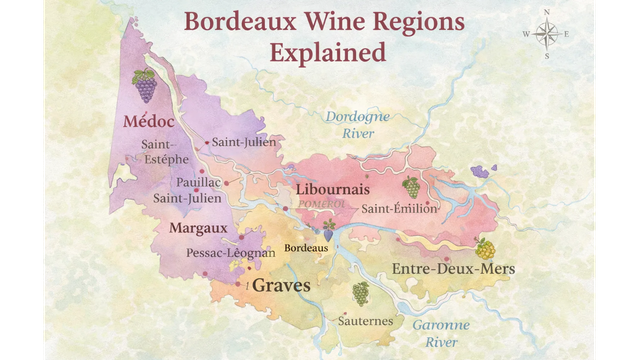
To understand this château, it helps to understand where it stands. Bordeaux’s Left Bank runs north from the city along the Gironde, and as it does the prestigious communal appellations fall away one by one — Margaux, Saint-Julien, Pauillac, Saint-Estèphe — until only the broader, humbler Médoc AOC remains. Established in 1936, the Médoc appellation covers the northern half of the peninsula, a patchwork of vineyards scattered between cereal fields, pasture and forest rather than the dense, uninterrupted rows found further south.
The soils here lean more heavily on clay than the gravel-dominated Haut-Médoc, and that difference shows up in the glass: Médoc reds tend to give a larger share to Merlot alongside Cabernet Sauvignon, producing wines that are generally rounder, more approachable and ready to drink sooner, without sacrificing the structure Bordeaux is known for. The proximity of the wide Gironde estuary and the Atlantic just beyond it also plays its part, moderating temperature extremes and helping the vines through the growing season.
Jau-Dignac-et-Loirac itself sits right at this meeting point of land and water — once an island, drained and reclaimed centuries ago, now a landscape of vineyards, salt marsh, small fishing ports and the wooden “carrelet” huts that still line the estuary. It is one of the villages entitled to use the Médoc appellation in its own right, and a fitting home for an estate built on artisanal, hands-on winemaking.
From Cellar Masters to Their Own Vines
The story of Château Les Graves de Loirac is, above all, a family story. Before working their own land, the Gillet family spent years as cellar masters (maîtres de chai) for another Médoc producer, learning the craft from the inside — the rhythms of the harvest, the patience of barrel ageing, the small decisions that separate a good vintage from an ordinary one. When they eventually struck out on their own, it was on a modest, still-young vineyard that they built up gradually, vintage by vintage.
That apprenticeship shows in the wines. Early vintages were noted for a deep, youthful colour and a structure that leaned austere in its first years but stayed well balanced, with oak handled carefully enough to let the fruit still speak. It is a house style rather than a single formula: a blend built primarily around Cabernet Sauvignon and Merlot, aged in a combination of tank and barrel, from vines farmed with sustainable practices and harvested by machine. Production is small by design — a few thousand bottles in a typical vintage — which is very much the point of the Cru Artisan philosophy the estate belongs to.
What “Cru Artisan” Actually Means
The Cru Artisan designation is one of Bordeaux’s oldest classifications and, for most of the twentieth century, also one of its most forgotten. It dates back more than 150 years, to a time when Médoc winegrowers were informally ranked below the aristocratic crus bourgeois — many of them literally artisans by trade, coopers or blacksmiths who also tended a small parcel of vines to support their families. The term fell out of use as the grand châteaux came to dominate Bordeaux’s image, and it was only revived in 1989, when a group of small producers formed the Union of Médoc Crus Artisans to lobby for its return. The European Union formally recognised the designation in 1994, and a defined list of estates began using it on their labels from the 2005 vintage.
What earns a château the right to the name has nothing to do with grand architecture or classified-growth pedigree. It is about scale and involvement: the owner must be personally hands-on in the vineyard and the cellar, bottling must happen at the property itself, and the wine is tasted every year to confirm it still meets the standard. In short, Cru Artisan status is a guarantee that the person whose name is on the label is also the person who picked the grapes.
A Taste of the Real Médoc
For a wine lover exploring Bordeaux beyond the famous names, an estate like Château Les Graves de Loirac offers something the grand crus rarely can: a direct, unpolished connection between the land, the family and the bottle. It won’t carry the price tag — or the marketing budget — of its classified neighbours further south, but it carries something else: a taste of the Médoc as it has been made for generations, by people who never stopped doing the work themselves.